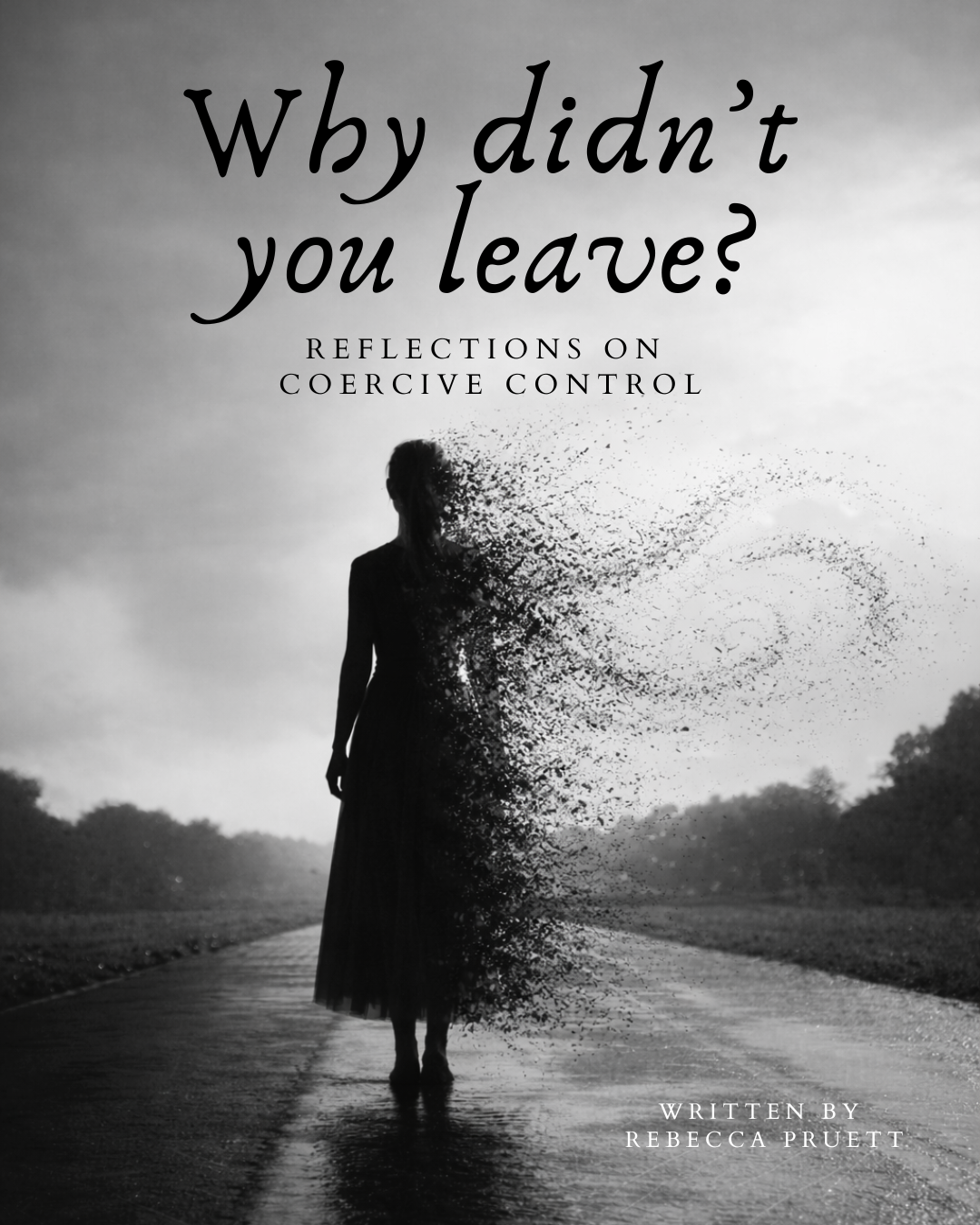
Why Didn’t You Leave
“When things were bad, what made you stay?”
I looked at the faces around the room—eyes glued to me, waiting patiently for my answer.
I wondered if this was the trauma-informed way of asking the blunt, familiar question so often imposed upon us.
I sat with it for a moment.
Let it pass through my mind—stripped of its finesse.
Why didn’t you leave?
I felt its sting.
In the moment, I didn’t know how to answer. I tried—awkwardly, imperfectly.
How do you explain coercive control to people who have never experienced it? How do you explain erosion of identity? The slow overriding of your will—systematic erasure of your personhood. The bizarre back-and-forth of disapproval and approval, that leaves you disoriented and confused. The collapse of self-trust, when every abuse received is framed as personal failure. The gaslighting that leaves you constantly second-guessing your perception.
How do you explain a world where there is no legitimate alternative to obedience? Where rules are layered upon rules, until a person loses any sense of normal. Where autonomy is not merely discouraged, but systemically punished. Where, one by one, the people you love are demonized and removed until you are totally isolated. Where your only feedback comes from a single source. Where a twisted theology reinforces pastoral abuse, and community celebrates the crushed will as if it’s the epitome of virtue. Where your broken, battered submission to every blow is proof of godliness.
How do you explain psychological entrapment—the sincerely held belief that another person—a pastor—owns you, and that resistance to him is both impossible and immoral?
Why didn’t you leave?
To the average person—someone whose autonomy has always been intact—staying is inconceivable.
Who would tolerate being treated so poorly?
Why wouldn’t you stand up for yourself?
But those questions only make sense in a world where choice is taken for granted.
Under coercive control, choice is foreign. The will is fractured, and fractured, and fractured—until there is no will left to resist. The smallest independent thought is too dangerous to sustain.
“Why didn’t you leave?” is a belittling, dismissive question—an intrusive affliction for those who have been harmed by coercive control.
It carries judgment.
It carries blame.
It assumes there were options.
I look back now and I think—How? With what?
Nearly every aspect of life became subject to control. Time. Technology. Finances. Lodging. Transportation. Relationships. Access to others. Future. Reputation. Even thoughts—instincts—feelings were policed. Boundaries were mapped out with precision and surgically dismantled.
The narrative of my life was hijacked—internally and externally—a pastor stood at the helm of what I believed about myself and what others believed about me. One was rebellious, rebuked, humiliated, and punished if one thought, contrary to the pastor’s will, flashed across the mind. The very notion of leaving was repeatedly framed as inviting God’s judgment—including sudden death—and that belief was paralyzing.
Within that system, the pastor defined reality.
Who was safe.
What was good.
What was evil.
What was acceptable.
What was obedience.
What was rebellion.
Conscience was trained to equate his will as God’s command.
Submission.
Loyalty.
Total subjugation.
That was the framework.
He was the pastor.
I was conditioned to believe I belonged to him.
In practice, his authority dictated who I was permitted to be, how I was allowed to function, and the boundaries of my existence.
Leaving was sinful—morally wrong.
People ask why you didn’t leave because they imagine a door—but coercive control creates a reality where no door exists.
No concept of autonomy.
No privilege of asserting the will.
No clue that personal rights are even a thing.
There wasn’t a door.
Almost every exit I have observed from a high-control religious group has been crisis-driven—born of rupture, not autonomy. The system implodes under its own weight, and the person is expelled by catastrophe, not because they woke up one day and suddenly chose freedom, but because their experience culminated in so much trauma that staying became physically, psychologically, and spiritually un-survivable. Agency—in these individuals—is something that takes years to restore, post-exit.
Every time I see or hear this question thrust upon a survivor—it horrifies me. “If it was so bad, why didn’t you just leave?” It is a moral obscenity that survivors are blamed for not walking through an exit that was eradicated from their mind, their framework, and their world. It is grotesque that when abuse is illuminated the first inclination is to overlook the abuse, ignore how the spirit was methodically crushed, and interrogate the victim’s failure to escape rather than the perpetrator’s right to dominate.
We were not choosing between staying and leaving.
We were stripped of choice: the most basic human dignity.
We were conditioned into psychological dependency, where the only. permissible. posture. was total subjection, and the smallest inclination toward independent thought—selfhood—came with severe consequences.
This was a world where abuse was spiritualized—harm was reframed as refinement—and suffering under authority was demanded as proof of godliness. This was a world where peace and safety were transactional, and could only be obtained by purest submission, absolute subservience, and total alignment with the will of authority.
Where “God-assigned” authority was understood as total ownership.
There was no alternative frame of reference.
So when you ask, “Why didn’t you leave?” you are imagining freedom where none existed.
No competing reality.
This is how coercive control works.
It does not rely on chains or locked doors—but on the systematic destruction of autonomy—on breaking the will until it disappears.
Choice is narrowed.
Then punished.
Then erased.
There is no meaningful exit.
There is no self left to assert.
“Why didn’t you leave?” assumes choice—
but coercive control is the annihilation of it.



You May Also Like
25 Years in Church—But I Can’t Remember Hearing the Gospel

Unless a Grain of Wheat Falls Into the Earth and Dies
